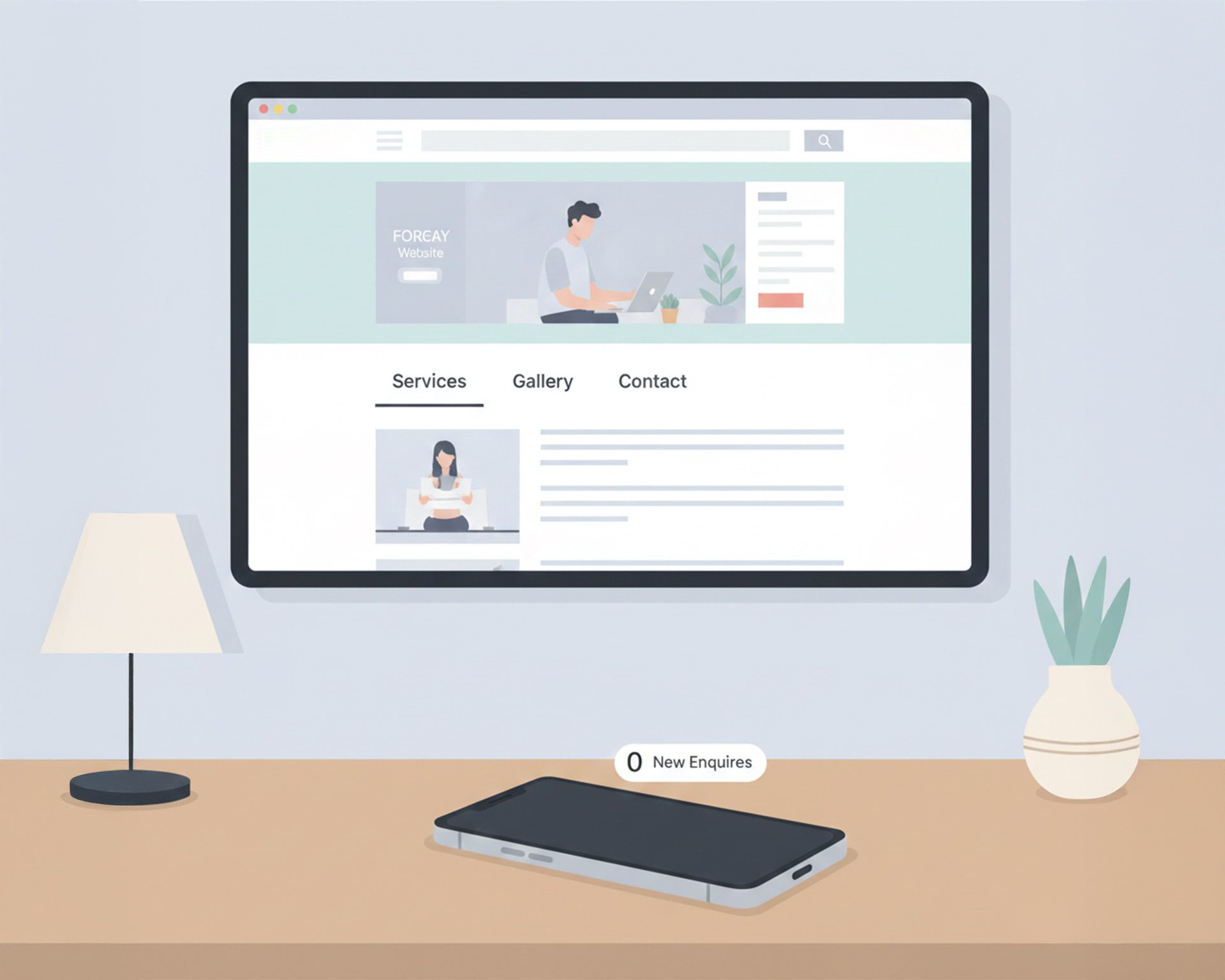
Most small businesses don’t really know why they have a website.
They just know they are supposed to have one.
So they get one built, or they build one themselves, put some information on it, add a contact page, and tick the box. Website done.
The problem is that most of these websites do very little to actually bring in work.
Websites built to showcase, not convert
A lot of small business websites are built from the inside out.
Here’s what I do.
Here’s my services.
Here’s my about page.
Here’s my logo.
They are essentially digital brochures. They showcase the business, but they do not guide the visitor.
Very little thought is put into what the visitor is actually trying to do when they land on the page. Even less thought is put into what action the business wants them to take next.
From the visitor’s point of view, the question is simple:
“Is this the right business for me, and how do I get in touch quickly?”
Most sites do not answer that clearly or confidently.
The “I just need a website” mindset
This is especially common with tradies and service-based businesses.
The thought process usually stops at:
“I need a website because I should have one.”
There is no deeper strategy. No reason for the site to exist beyond legitimacy.
DIY builders are often used, which is totally fine. The issue is not DIY. The issue is that the website ends up being a dumping ground for information rather than a tool designed to win enquiries.
A homepage full of paragraphs about the business does not help someone who is actively looking for a solution.
Why most homepages are the wrong destination
Homepages try to do too many things at once.
They talk to everyone.
They explain everything.
They lead nowhere.
For someone arriving from Google or an ad, this creates friction. The visitor has intent, but the page does not respond to it.
In most cases, sending traffic to a homepage is one of the biggest reasons websites fail to convert.
More traffic is not the answer
More traffic sounds good, but traffic without intent is mostly useless.
You can increase traffic and still get no enquiries. You can even increase traffic and make things worse by confusing the wrong people.
What actually matters is matching intent with a clear, focused page that answers one problem and leads to one action.
This is where most small business websites fall over.
Simplicity is not laziness
Simple gets confused with cheap or lazy.
In reality, simplicity is hard. It requires clarity.
A useful page removes distractions. It focuses on one job. It speaks directly to the person who has landed there and makes the next step obvious.
Most businesses are sold complexity they do not need. Extra pages, extra features, extra explanations that do not move the needle.
What a website should actually do
At its core, a small business website has one primary job.
Turn interested visitors into enquiries.
Everything else is secondary.
That does not mean you need to rebuild your entire website. In many cases, the main site can stay exactly as it is.
What is missing is a focused, conversion-oriented layer.
Where Quick Pages fits
Quick Pages was built to solve this exact problem.
Not by replacing existing websites.
Not by forcing people into a CMS.
Not by adding unnecessary complexity.
Quick Pages uses static HTML landing pages built for very specific campaigns and use cases. They are fast, focused, and intentional.
You would not build your whole website this way. That is not the point.
The point is to give small businesses access to top-tier agency and CMO-level thinking without the agency price tag. The strategy, structure, and insight that normally sits behind expensive campaigns is baked into a system that works alongside what you already have.
It is for DIY businesses that want to take things to the next level, not start from scratch.
The real shift
The shift is not about having a website.
It is about having pages that actually do something.
That is the difference between a site that exists and a site that helps you get work.